Know your Mass
The sacred vessels of the Mass
Every time you walk into a church for Mass, something extraordinary is about to happen. The vessels on that altar are not religious décor. They are the instruments through which heaven touches earth — and most Catholics could not name more than two of them.
Why they are held in special honour
The General Instruction of the Roman Missal singles them out, and gives pride of place to the chalice and paten, in which the bread and wine are offered, consecrated, and consumed. The reasoning is simple enough that it is easy to miss: these objects touch the Body and Blood of Jesus Christ.
The vessels are to hold the Lord, and they should all be worthy of Him.General Instruction of the Roman Missal
What they are made of
Precious metal, as a rule. If a vessel is made of a metal that rusts, or of something less precious than gold, it is to be gilded on the inside. The Church explicitly rejects the use of common containers, of anything lacking artistic merit, and of glass, earthenware, or clay — materials that break easily.
This is not elitism about tableware. It is a theological claim: the God who became flesh is owed the best that human hands can make.
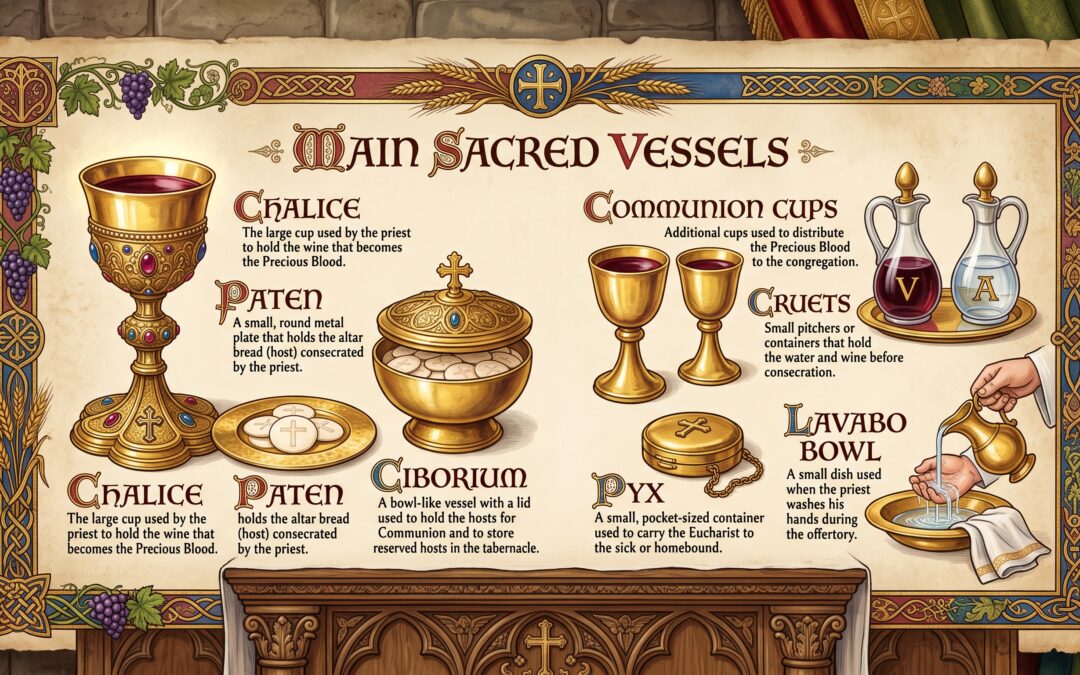
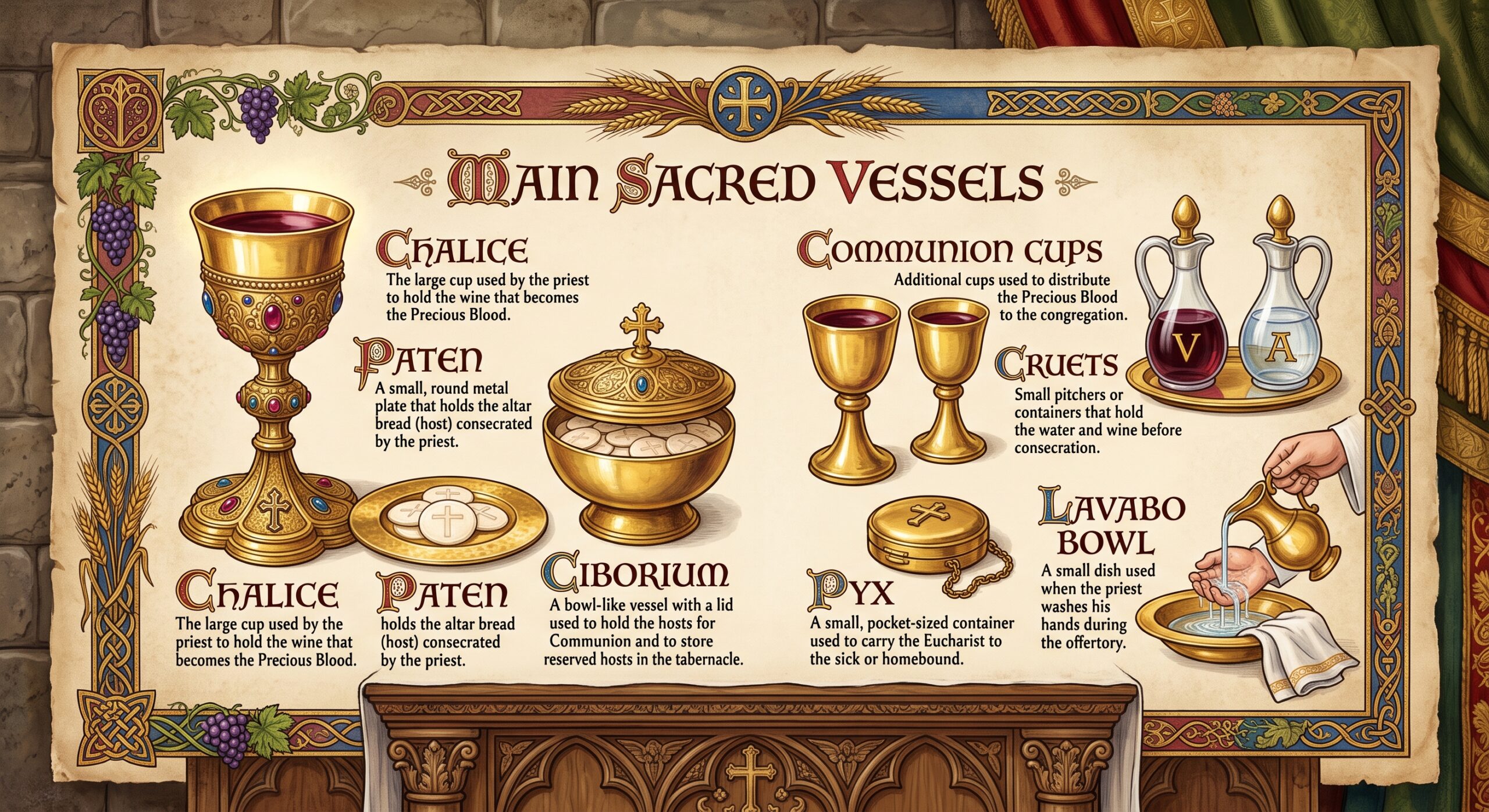
The six vessels
The Chalice
KAL-iss
The cup that holds the wine which becomes the Precious Blood. Its bowl must be of a material that does not absorb liquid, and its base wide enough that it cannot easily be tipped over.
The knob partway up the stem is not decoration. After the consecration the priest holds his thumb and forefinger together, and the knob is what lets him lift the chalice without losing his grip. Every element of the shape is answering a practical need created by reverence.
The Paten
PAT-en
The shallow dish that holds the bread. Made of the same metal as the chalice, and gilded on the inside if it is anything less than gold.
Its edge is deliberately thin and sharp, so that the smallest particles can be gathered from the corporal. That detail tells you what the Church believes about what rests on it.
The Ciborium
sih-BOR-ee-um
A covered vessel, shaped like a chalice but with a rounded bowl and a lid topped by a cross. It holds the consecrated hosts for distribution at Communion, and reserves them in the tabernacle afterward.
The name may come from the Latin cibus, food, or the Greek kiborion, cup. While it holds the Blessed Sacrament it is veiled, and only sacred ministers handle it.
The Monstrance
MON-strance
The framed shrine in which the Blessed Sacrament is exposed for adoration. Its most common form is a sun with rays streaming outward — a deliberate argument in gold that Christ is the light of the world.
It exists for one purpose: so that the faithful can look at the God who has hidden Himself under the appearance of bread. Also called an ostensorium, from the Latin for “to show.”
The Pyx
PICKS
A small round box for carrying the Blessed Sacrament to the sick.
It is the most pastoral of the vessels and the least impressive to look at. Every hospital visit, every homebound parishioner, every prisoner who receives Communion receives it from one of these.
The Lunula
LOO-nyoo-la
A small crescent-shaped clip inside the monstrance that holds the Host upright and visible. Also called a lunette.
The smallest vessel on this list, performing a task nothing else can: holding God before the eyes of His people.
And the linens that serve them
Not vessels, but they work in close partnership with them, and they are governed by the same logic of reverence.
The Corporal
A square of white linen, roughly twenty inches, spread on the altar beneath the vessels. Its job is to catch any particle of the consecrated Host. Hosts are transferred between vessels over it, never away from it.
The Purificator
A folded linen cloth used to wipe the chalice and the priest’s fingers during and after Communion. Because it touches the Precious Blood, it is purified in water before ordinary laundering, and that water is poured into the sacrarium rather than a drain.
The Pall
A stiffened linen square laid over the mouth of the chalice to keep anything from falling in.
Why any of this matters
None of this is trivia. The care the Church takes with a thin-edged paten and a square of linen is an argument about what is actually happening on the altar. You cannot treat a crumb that way and believe it is only bread.
Next Sunday, watch the priest’s hands after the consecration. Watch what happens to the corporal. The theology is right there in the choreography.
Quotations are drawn from the General Instruction of the Roman Missal and from Redemptionis Sacramentum. Definitions of the older terms follow the Catholic Encyclopedia.